Open-house staging fills rooms with medium-sized, inoffensive things. Camera staging does the opposite: it empties, enlarges and commits. If your home earns income as a location, the difference is worth understanding — it is often the gap between one booking a year and one a month.
The lens adds clutter
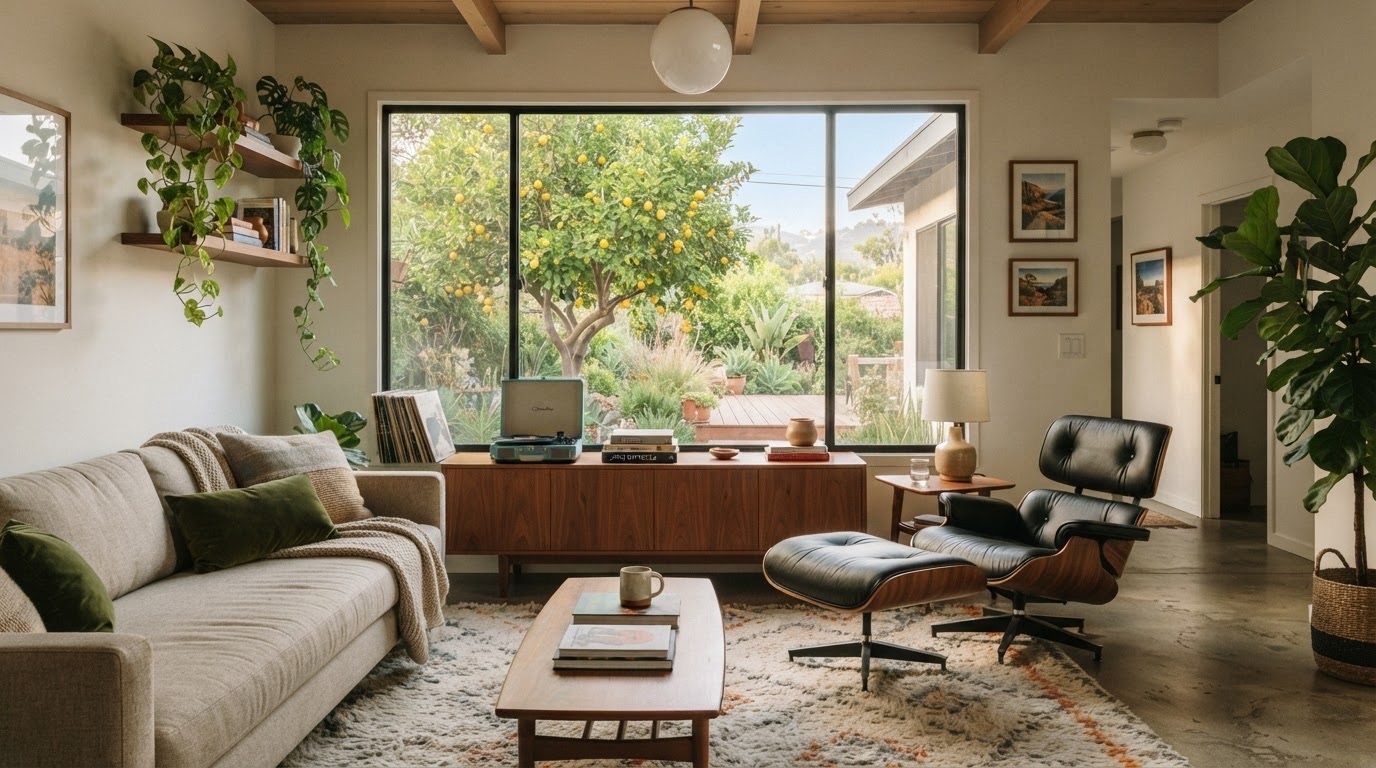
A 24mm lens compresses a room’s contents into a single plane, so a space that feels “furnished” in person reads as crowded on screen. The working rule from our art-department partners: remove a third, then double the scale of what remains. One substantial sofa photographs; three occasional chairs do not.
Commit to a point of view
The homes that book constantly are never neutral. Palmcrest books because it is unapologetically 1959. The Curio House books because every room commits to a color. Productions can rent neutral anywhere — character is the scarce commodity, and owners who lean into their home’s actual era and personality see it directly in the calendar.
Productions can rent neutral anywhere. Character is the scarce commodity.
Leave room for their story
The best location homes hold a strong shell with movable contents: art that can come down in an hour, rugs that roll, a garage bay that becomes a staging room. When we onboard a property, we catalog exactly this — what stays, what moves, how fast — so an incoming designer knows the house will meet them halfway.